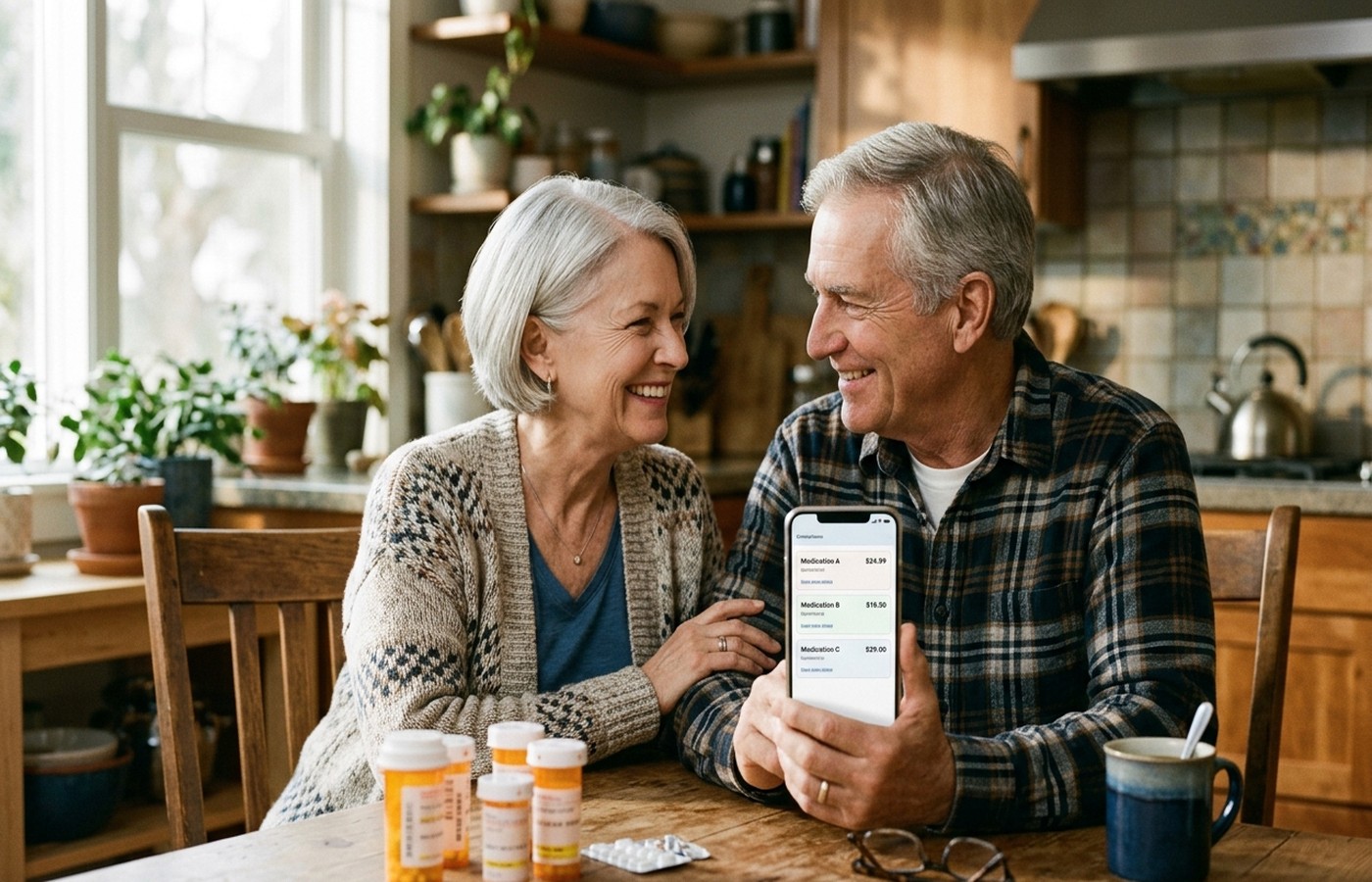
Prescription drug discount cards are one of the most widely available tools for reducing medication costs — yet many patients are unsure exactly how drug discount cards work, when to use them, or how they differ from insurance. Understanding how these cards work helps you use them strategically to maximize savings every time you fill a prescription. This guide explains how prescription drug discount cards work, step by step, and how to use them to get the best price on your medications.
Use RxDiff's free prescription discount comparison tool to see how discount card prices compare at pharmacies near you.
Disclosure: RxDiff brand content. Prescription discount cards are not insurance and cannot be used simultaneously with insurance at the pharmacy counter. Not valid with Medicare or Medicaid. Savings vary by drug, dosage, and pharmacy.
What Are Prescription Drug Discount Cards?
Prescription drug discount cards — also called drug discount cards, pharmacy discount cards, or prescription savings cards — are programs that give patients access to negotiated cash prices on prescription medications at participating pharmacies. Prescription discount cards are not insurance, and they work differently from health coverage in important ways.
Prescription discount card programs are available to virtually anyone — uninsured patients, insured patients whose copay is higher than the cash price, patients with high deductible health plans, and even Medicare beneficiaries for medications not covered by their Part D plan. The cards are typically completely free to obtain and use.
How Drug Discount Cards Work — The Mechanics
Here is exactly how prescription discount cards work when you use one at the pharmacy:
- 01The card accesses a negotiated price network
Each discount card program has contracts with pharmacy benefit managers (PBMs) — intermediaries that negotiate drug pricing. These contracts give the program access to discounted cash prices at participating pharmacies, which the program then makes available to cardholders.
- 02You search for your medication price
Search your drug name, dosage, and zip code on the discount card program's website or mobile app. The program shows you the negotiated price available at pharmacies near you — before you even leave home.
- 03You present the card at the pharmacy counter
Show the card, coupon, or mobile app to the pharmacist. The card includes a BIN number, PCN code, and Group number that the pharmacist enters into the pharmacy system to access the negotiated price.
- 04The pharmacy processes the transaction
The pharmacy looks up the negotiated price through the PBM network using the card's codes. The pharmacy receives a small administrative fee from the PBM network when you use the card — which is how these programs generate revenue while remaining free to patients.
- 05You pay the discounted cash price
You pay the negotiated cash price directly — no insurance claim, no reimbursement, no waiting. The savings of up to 80% compared to standard retail prices are applied immediately at the point of sale.
What Prescription Discount Cards Work For
Prescription discount cards are designed to help anyone access lower prescription drug prices. Here is when they work best and when they have limitations:
- Generic medications — largest savings vs. retail
- Uninsured patients paying full cash price
- High deductible plan holders before deductible is met
- Drugs not covered by insurance formulary
- When cash price beats insurance copay
- Anyone who can't afford their medications at retail price
- Cannot be used simultaneously with insurance
- Not valid with Medicare Part D
- Not valid with Medicaid
- Does not count toward your deductible
- Prices vary by pharmacy and change over time
- May not cover all drugs at all pharmacies
Pharmacy Benefit Managers — Who Negotiates the Prices
Pharmacy benefit managers (PBMs) are the intermediaries that negotiate drug prices between pharmaceutical manufacturers and pharmacies. The same PBMs that power insurance company drug benefits also power prescription discount card programs — though under different contract terms.
When discount card companies access PBM networks, they aggregate millions of users to negotiate favorable pricing. The pharmacy benefit managers work with discount drug card programs to establish pre-negotiated prices at participating pharmacies nationwide. This structure allows discount cards to offer prices significantly below standard retail rates even though no insurance company is involved.
Different discount card programs use different PBMs or have different contracts with the same PBMs — which is why prices vary across programs like GoodRx, SingleCare, WellRx, and RxDiff for the same medication at the same pharmacy. Using a comparison tool like RxDiff that checks all programs simultaneously ensures you always access the best available PBM-negotiated price.
Best Prescription Discount Cards — Programs Compared
| Program | Network | Cost | Best For |
|---|---|---|---|
| RxDiff | 70,000+ | Free | Comparing all programs at once |
| GoodRx | 70,000+ | Free (Gold: $9.99/mo) | Largest brand recognition |
| SingleCare | 35,000+ | Free | Best price on generics |
| ScriptSave WellRx | 65,000+ | Free | Brand-name discounts |
| Optum Perks | 60,000+ | Free | Patients with UnitedHealth coverage |
ScriptSave WellRx and Other Discount Programs
ScriptSave WellRx is a free prescription discount card program with one of the larger pharmacy networks available to patients seeking alternatives to GoodRx. WellRx works through its own PBM contracts to deliver discount card prices at over 65,000 participating pharmacies, and is particularly noted for competitive pricing on brand-name medications.
Like all prescription discount card programs, WellRx prices vary by medication and pharmacy location. One of these cards — WellRx, GoodRx, SingleCare, or others — may have the best price on your specific medication, which underscores the importance of comparing multiple programs before each fill.
How to Use Prescription Discount Cards — Practical Tips
Use the discount card's mobile app or website to compare prices at nearby pharmacies before leaving home. This lets you choose the pharmacy with the lowest price for your specific prescription.
Explicitly tell the pharmacist you want to use a discount card pricing. Provide the BIN, PCN, and Group numbers. If the price doesn't match what you saw online, ask the pharmacist to re-enter the information.
Use RxDiff to compare prices across all major discount card programs at once. Different cards may show significantly different prices for the same drug at the same pharmacy.
Even if you have insurance, compare the discount card cash price against your copay for each prescription. For many generic medications, paying cash with a discount card is cheaper than using your insurance copay.
Discount Cards vs. Health Insurance — Key Differences
Prescription discount cards and health insurance work very differently. Understanding these differences helps you decide when to use each option.
How they work: Insurance pays a portion of drug costs after your deductible and copay. A discount card gives you access to a pre-negotiated cash price — you pay the full discounted amount directly.
Deductible impact: Using insurance counts toward your annual deductible and out-of-pocket maximum. Using a discount card does NOT count toward your deductible — a critical distinction for patients with high deductible plans who are trying to maximize their insurance benefits.
Cost: Insurance requires monthly premiums. Most prescription discount card programs are completely free to use, with no premium or transaction fee.
Can you use insurance? Prescription discount cards cannot be used simultaneously with insurance at the pharmacy. You must choose one or the other for each prescription fill. Compare both prices before deciding.
Optum Perks and Other Discount Card Options
Optum Perks is a prescription discount card program offered by Optum, a subsidiary of UnitedHealth Group. Like other discount programs, Optum Perks offers negotiated cash prices at participating pharmacies nationwide and is free to use.
Optum Perks and programs like it are part of a growing ecosystem of prescription discount card companies that compete on price and network coverage. No single program consistently offers the best price for every medication — comparing across programs including Optum Perks, GoodRx, SingleCare, WellRx, and RxDiff before each fill is the most reliable strategy for finding the lowest prescription price.
FAQ — How Prescription Discount Cards Work
Prescription discount cards work by providing access to pre-negotiated drug prices through pharmacy benefit managers (PBMs). Present the card at a participating pharmacy and the pharmacist applies the negotiated cash price — often significantly lower than the standard retail price. The cards are typically free, require no membership, and prescription discount cards can help anyone regardless of insurance status. Use RxDiff to compare prices across all programs at once.
A prescription discount card gives you access to a negotiated cash price — you pay the discounted price directly at the pharmacy. Insurance pays a portion of your drug costs after your deductible and copay. Discount cards cannot be used simultaneously with insurance, do not count toward your deductible, and have no monthly premium. For many generic medications, the discount card cash price is actually lower than an insurance copay.
Yes — most prescription discount cards are completely free to obtain and use, including RxDiff, GoodRx, SingleCare, and ScriptSave WellRx. These programs generate revenue through small administrative fees paid by pharmacies when patients use the card — there is no cost to the patient. Some programs offer optional paid tiers (like GoodRx Gold) for additional discounts, but the free tiers provide substantial savings for most patients.
Prescription drug discount cards work at participating pharmacies — which for major programs includes most national chains (CVS, Walgreens, Walmart, Kroger, Costco) and thousands of independent pharmacies. Coverage varies by program. Use RxDiff to verify which pharmacies participate for your specific medication and find the best price near you.
Find the Best Prescription Discount Card Price Near You
Use RxDiff's free comparison tool to compare all major discount card programs at 70,000+ pharmacies — instantly, free, no account needed.
Compare Discount Card PricesNot valid with Medicare or Medicaid. Cannot be used simultaneously with insurance. Savings vary by drug, dosage, and pharmacy.