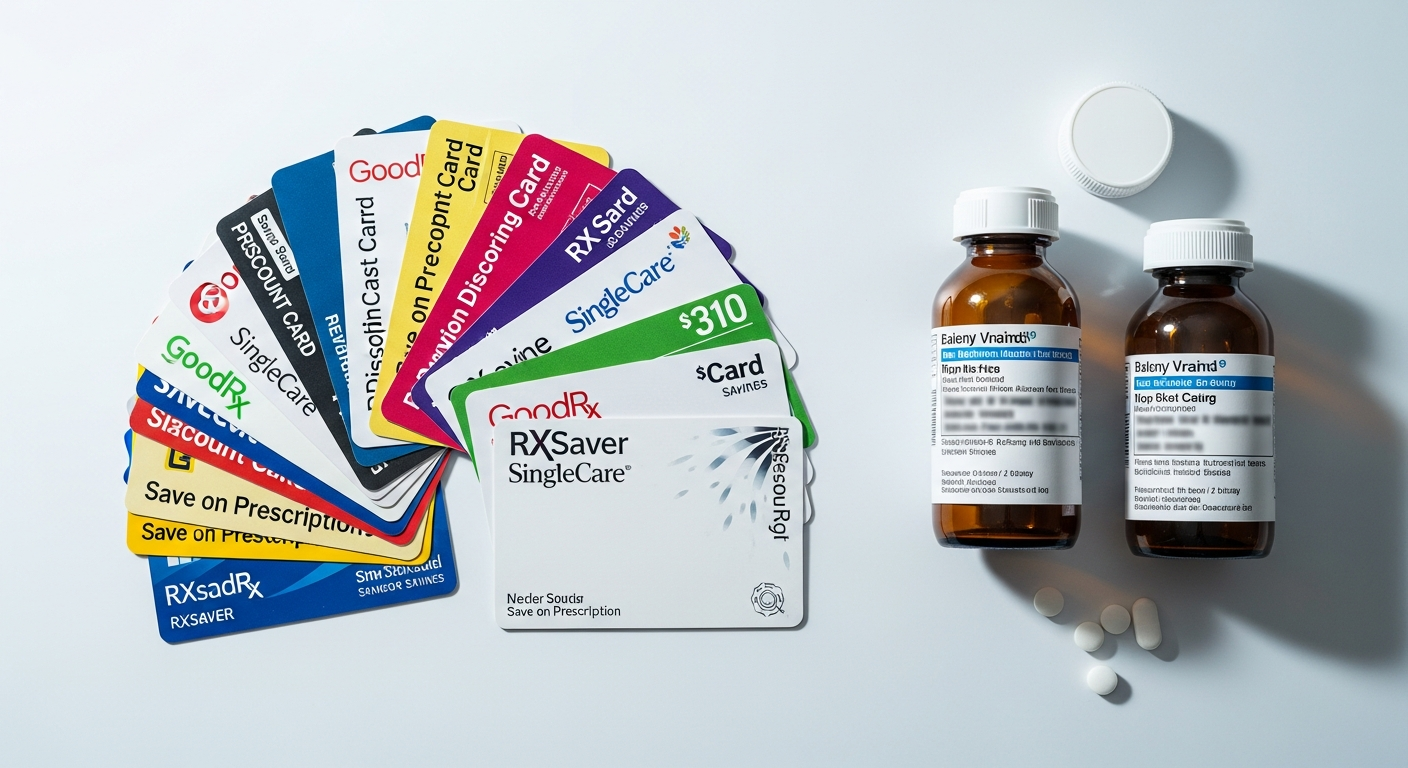
Prescription discount cards are everywhere — GoodRx on TV, SingleCare at the pharmacy counter, BuzzRx in your email. But most people using them don't actually know how they work. They just know they're free and the price is lower. That's enough to use one, but understanding the mechanism helps you use them smarter.

Here's a plain-English explanation of what prescription discount cards are, how they lower drug prices, and what they can and can't do for you.

What Is a Prescription Discount Card?

A prescription discount card is a free card or coupon that gives you access to pre-negotiated drug prices at participating pharmacies. When you show it at the counter, you pay the discounted price instead of the full retail price — with no insurance required.

The U.S. Department of Health and Human Services recognizes prescription discount programs as a supplement to — not a replacement for — health insurance.

Prescription discount cards are not insurance. They don't require a monthly premium, an enrollment period, or even a sign-up in most cases. They're simply a tool that lets you tap into pricing agreements that card companies have already negotiated with pharmacies on your behalf.

Free discount cards are available from companies like GoodRx, SingleCare, BuzzRx, WellRx, Optum Perks, and RxDiff. All of them work on the same basic principle — they just have different negotiated rates with different pharmacy networks, which is why prices vary from card to card.

How Do Prescription Discount Cards Work?

Prescription discount cards work by connecting you to pre-negotiated drug prices arranged between card companies and pharmacy benefit managers (PBMs). The pharmacy looks up your card's contracted rate and charges you that lower price instead of the retail list price.

The full mechanism behind discount cards involves a middleman most patients never hear about: pharmacy benefit managers, or PBMs. Here's how the chain works from start to finish:

1
Card companies negotiate with PBMs
Prescription discount card companies like GoodRx and SingleCare negotiate discounted drug prices with large pharmacy benefit managers. PBMs have contracts with thousands of pharmacies, giving card companies access to a broad pharmacy network.
2
Pharmacies agree to honor the rates
Participating pharmacies agree to accept the pre-negotiated prices in exchange for being part of the network. Most major chains — CVS, Walgreens, Walmart, Kroger, Costco — and many independent pharmacies participate.
3
You show the card at the pharmacy counter
When you present your discount card or coupon at the pharmacy, the pharmacist enters the card's BIN, PCN, and group number into their system. These codes identify which PBM contract applies to your transaction.
4
The system returns the discounted price
The pharmacy's system looks up the pre-negotiated rate for your specific medication and dosage. You pay that lower price — not the retail list price.
5
The card company earns a small transaction fee
This is how free cards generate revenue without charging you. The pharmacy pays a small per-transaction fee to the card company — typically a few dollars. You pay nothing extra beyond the discounted drug price.
Why prices vary between cards: Each card company has different contracts with different PBMs. That's why GoodRx might show $18 for a drug while SingleCare shows $14 at the same pharmacy. The negotiated rates are genuinely different — not marketing spin. This is why comparing before you fill is always worth doing.

How to Use a Prescription Discount Card

Using a prescription discount card takes three steps: search your medication to find the lowest price, bring the card or coupon to the pharmacy, and show it to the pharmacist when you pick up your prescription.
  1. Search your medication and dosage

    Use RxDiff or your preferred card's app to search your medication, dose, and quantity. You'll see prices at nearby pharmacies — these are the actual prices you'll pay at the counter.

  2. Pick the best price at a convenient pharmacy

    Compare prices across nearby pharmacies. The same drug at the same card can vary by $20 or more depending on the pharmacy location. Choose the pharmacy that gives you the lowest price for your medication.

  3. Show the card or coupon at the counter

    At the pharmacy, show the pharmacist your discount card, app coupon, or printed voucher before they ring up your prescription. Make sure they use the card — not your insurance — for this transaction.

  4. Pay the discounted price

    That's it. No forms, no waiting period, no claim to file. The discount applies immediately at the point of sale.

How Much Can You Save with a Prescription Discount Card?

Prescription discount cards can save up to 80% compared to retail pharmacy prices. Generic medications see the largest discounts — often bringing a 30-day supply below $10. Brand-name drugs see smaller but still meaningful savings.

Here's a real-world savings example for a common generic medication — lisinopril, one of the most prescribed blood pressure drugs in the U.S.:

💊 Lisinopril 10mg, 30-day supply — Price Comparison
Retail price (no card) $35–$80
With GoodRx ~$9
With SingleCare ~$7
With RxDiff (best price) as low as $4

Generic medications like metformin, atorvastatin, gabapentin, and omeprazole frequently drop below $10 with a discount card — sometimes as low as $4 for a 30-day supply at the right pharmacy.

Brand-name and specialty medications see more variable savings. Discount cards can still reduce the out-of-pocket cost compared to retail price, but savings are typically smaller than on generics.

Can You Use a Discount Card Instead of Insurance?

Yes — you can always use a prescription discount card instead of insurance whenever the card price is lower than your copay. You simply show the discount card instead of your insurance card at the pharmacy counter.

This is one of the most practical applications of a savings card. Many people assume they have to use insurance for every prescription — but you can choose whichever option is cheaper at the time of purchase.

It's especially worth choosing the price reduction card when:

Important: Discount card purchases do not count toward your insurance deductible or out-of-pocket maximum. If you're tracking spend toward your deductible — particularly later in the year — factor this into your decision. Sometimes using insurance is the better long-term choice even if the card is cheaper today.

What Can and Can't Prescription Discount Cards Do?

Prescription savings cards can lower your drug costs significantly on most medications at most pharmacies. They cannot be used alongside insurance, don't count toward your deductible, and aren't accepted at every drugstore.
✓ What Price reduction Cards Can Do
  • Lower the price of generic medications, often dramatically
  • Reduce cost on brand-name prescription drugs
  • Work without insurance — no coverage required
  • Be used at most major the store chains nationwide
  • Save money instantly — no waiting, no claims
  • Work on brand and generic medications
  • Be used by anyone — no income or eligibility requirement
✕ What Savings Cards Can't Do
  • Be combined with insurance on the same prescription
  • Count toward your insurance deductible
  • Cover every the location (some independents opt out)
  • Replace insurance for high-cost specialty medications
  • Guarantee the lowest price on every drug at every location
  • Be used for controlled substances at some pharmacies

Which Prescription Discount Card Is Best?

No single card is cheapest on every medication at every pharmacy. GoodRx, SingleCare, BuzzRx, and WellRx all have different negotiated rates — the best reduced rate card for you depends on your specific drug and your local the chain.
Card Cost Pharmacies Best Known For
GoodRx Free 70,000+ Wide recognition, strong on popular generics
SingleCare Free 35,000+ Often beats GoodRx on common generics
BuzzRx Free 60,000+ Brand-name drugs, independent pharmacies
WellRx Free 65,000+ Easy comparison app, strong drugstore network
GoodRx Gold $9.99/mo Select only Lower prices at participating Gold pharmacies
RxDiff Free 70,000+ Compares all cards in one search automatically

The practical answer: use RxDiff to compare prices across all major cards before you fill each prescription. It takes seconds and ensures you're always getting the best prescription lower price available on your specific medication at your nearest pharmacies.

Find the Best Prescription Discount Price

Search your medication on RxDiff to compare prices across GoodRx, SingleCare, BuzzRx, WellRx, and more — free, instant, no account needed.

Compare Prescription Prices →

Frequently Asked Questions

Medication price reduction cards work by giving you access to pre-negotiated drug prices arranged between card companies and the store benefit managers (PBMs). When you show your card at the pharmacy, the pharmacist looks up the contracted rate for your medication and charges you that lower price instead of the full retail price. The card company earns a small per-transaction fee paid by the pharmacy — not by you.

Yes — major cards like GoodRx, SingleCare, BuzzRx, WellRx, and RxDiff are completely free to use. No membership fee, no sign-up required, no personal information needed in most cases. The card companies earn revenue through small transaction fees paid by the pharmacy, not by you.

You cannot use a drug lower cost card and health insurance at the same time for the same your Rx — you choose one or the other at the drugstore counter. It savings do not count toward your insurance deductible or out-of-pocket maximum. Use whichever option gives you the lower price on that specific fill.

Yes. Your meds price reduction cards cover both generic medications and brand-name medication drugs. Savings on generics are typically largest — often 60–80% off retail. Savings on brand-name drugs are more variable but can still be meaningful compared to the retail list price.

No. When you use a drug reduced rate card instead of your insurance, the purchase does not count toward your insurance deductible or annual out-of-pocket maximum. If tracking your deductible matters to you — particularly later in the year when you may be close to meeting it — consider whether using insurance makes more sense even if the card price is lower today.

No single card is cheapest on every drug at every pharmacy. GoodRx, SingleCare, BuzzRx, and WellRx all have different negotiated rates that vary by medication and location. The best approach is to compare prices across cards before filling each your Rx — RxDiff does this automatically in one search, showing you the best available your meds lower price for your specific medication at nearby pharmacies.